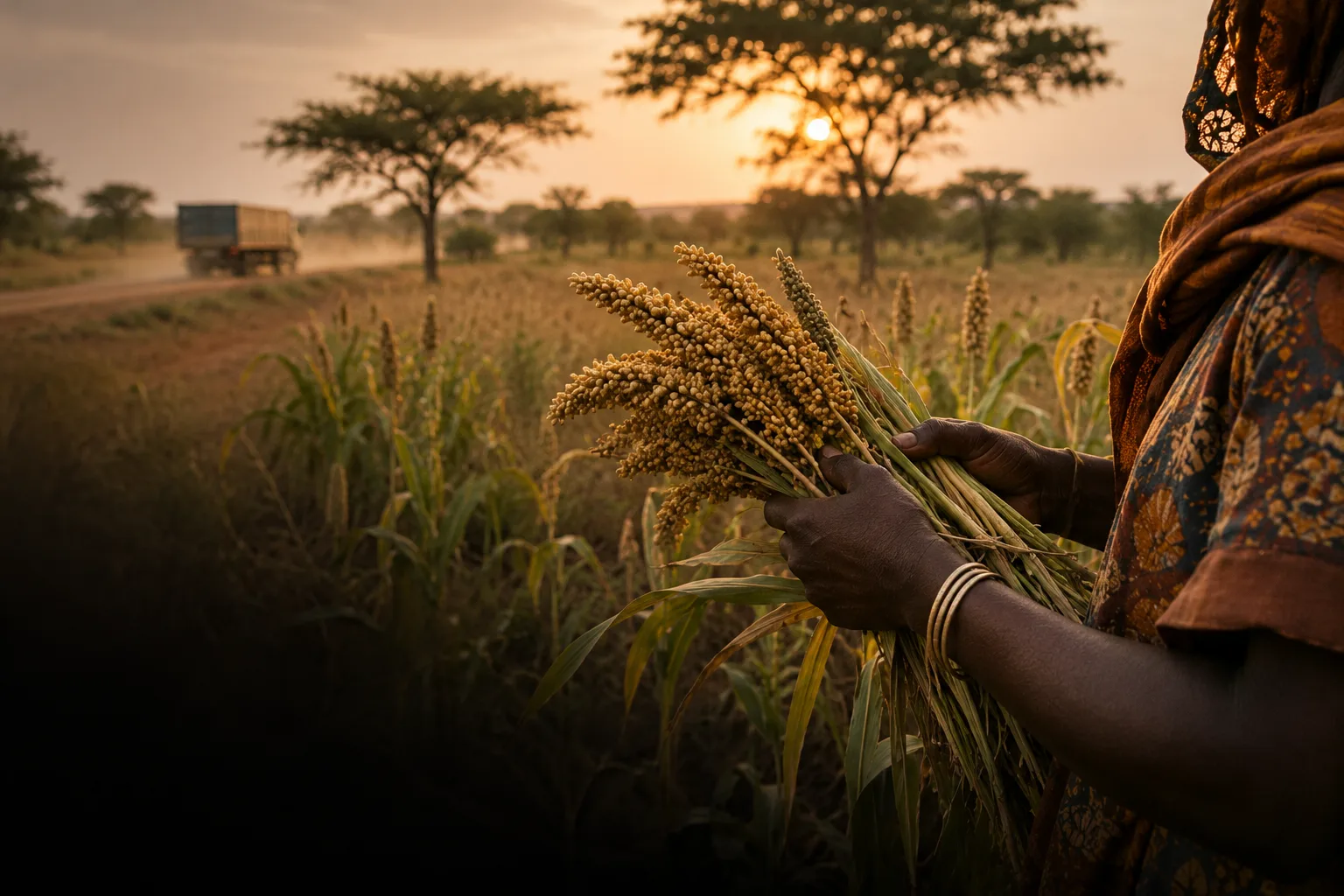
In the Sahel, a woman harvests millet from a field that ten years ago was bare ground. Further south, in a market in Lagos or Abidjan, families pay more each month for food that has crossed an ocean. Between that field and that market, distance is not the main obstacle. What separates them is a border post, a missing road, a standard that is not recognised on the other side, a cold store that was never built.
For two decades, Africa has invested its political will in restoring land. That work matters, and it is bearing fruit: soils are returning, farmers are coming back, communities are staying. But restored land answers only half of the question. The other half is what happens to the harvest once it leaves the field.
A sorghum surplus in one country should meet a shortage in another. Too often it does not. It rots in storage, sells at a loss in a saturated local market, or is never planted at all, because the farmer knows there is no buyer within reach. Today, trade between African countries still accounts for only around 16 percent of the continent's total trade. Most of what we eat travels a long way to reach us, while what we grow struggles to travel a short way.
What it takes
Food moves when four conditions are met.
- Corridors that work for perishable goods: roads, rail and border crossings where a truck of onions does not wait for days.
- Common standards. A tomato certified safe in Niger should be accepted as safe in Nigeria. Harmonised sanitary and quality rules do more for farmers than many subsidies.
- Processing close to production. Drying, milling, packaging and cold storage near the fields keep value in rural areas, create work for young people and allow goods to travel.
- Finance that reaches small producers and traders, who carry most of the continent's food but rarely qualify for credit.
None of this is new thinking. What is new is that the instruments now exist to act on it at scale.
A question of sovereignty
A country that cannot feed itself negotiates from a position of weakness. Every shock elsewhere, a war, a pandemic, a disruption to shipping, reaches African tables as a rise in prices. A continent that grows its own food and trades it within its own borders is not closing itself to the world. It meets the world on firmer ground. Food sovereignty is not self-isolation. It is the ability to choose.
Joining what already exists
Africa has already done the hardest part: it has agreed. On one side, the Great Green Wall has grown from a Sahelian ambition into a continental commitment to restore land. On the other, fifty African states have ratified the agreement creating a single continental market. These are two of the most important decisions our leaders have taken in a generation.
The work ahead is to bring them together. Restored land should be seen as the supply base of the continental market, and the continental market as the outlet that makes restoration pay. When a farmer in the Sahel knows her harvest can reach a buyer two borders away, she plants more, invests more and stays on her land. That is how restoration becomes an economy, and how an economy becomes resilience.
The land is coming back. Now it must be free to travel.